🎧 Listen to this article:
TL;DR — Quick Summary
An electric vehicle accident attorney will tell you that EV crashes involve more potential defendants than standard car accidents. The driver, manufacturer, software provider, and charging station operator can all share liability depending on what happened.
Electric vehicles are everywhere in California now. Tesla, Rivian, Chevy Bolt, Ford F-150 Lightning — they’re on every freeway and in every parking lot. Most people driving them assume that if they get into a crash, the process works the same as any other car accident. It doesn’t. And if you’re the one who gets hurt, that assumption can cost you.
EV accidents involve a set of legal questions that don’t come up in standard car crash cases. The technology is different, the potential defendants are different, and the evidence you need to protect your claim disappears faster. Here’s what you need to know before you talk to anyone — including the insurance company.
Why Electric Vehicle Accidents Are More Legally Complex
In a regular car accident, the question is usually straightforward: which driver was negligent? Someone ran a light, someone was speeding, someone wasn’t paying attention. The liability analysis starts and often ends with the people behind the wheels.
EV accidents can involve all of that, but they layer in additional questions that traditional crashes don’t raise. Was the autopilot or driver-assist feature engaged? Did the battery sustain damage that’s going to create a fire risk days from now? Was there a software defect that contributed to what happened? Did the charging station equipment play any role?
Each of those questions points to a potentially different liable party. And each of them requires different evidence to pursue.
Who Can Be Held Liable in an Electric Vehicle Accident
The driver is still the starting point. If someone ran a stop sign, changed lanes without looking, or was distracted and hit you, that’s standard negligence and it applies to EV drivers the same as anyone else. The car being electric doesn’t change the basic rules of the road.
But it can expand who else shares responsibility.
The Manufacturer
The manufacturer becomes relevant when the accident was caused or made worse by a defect in the vehicle itself. This includes battery fires that occur during or after a crash, software failures that caused unexpected acceleration or braking, autopilot or lane-keeping systems that malfunctioned, and design issues that made the vehicle more dangerous in a collision than it should have been. Product liability claims against EV manufacturers are a growing area of personal injury law, and California courts have handled several of them involving Tesla’s Autopilot system specifically.
Software and Technology Providers
Here’s where it gets more complicated. The company that built the software running the car’s assist features isn’t always the same as the company that built the car. And when Autopilot or a lane-keeping system does something wrong in the seconds before a crash, that software developer can end up in the defendant’s chair right alongside the automaker. The key question is whether the feature was active and whether it contributed to what happened. If both answers are yes, that’s a separate claim that most accident victims never think to pursue.
California leads the nation in autonomous vehicle testing and deployment. Per the California DMV Autonomous Vehicle Regulations, the state has specific rules governing how these systems must operate and report incidents — which means more documentation exists to support your claim than in other states.
Charging Station Operators
Charging station operators are an often-overlooked source of liability. If faulty charging equipment damaged a battery pack before an accident, or if an electrical malfunction at a charging station contributed to a fire or vehicle failure, the operator of that station may be liable. Major charging networks carry premises liability coverage for exactly this reason. An experienced electric vehicle accident lawyer will investigate all three sources of liability — not just the driver — to make sure nothing is left on the table.

The Battery Fire Problem
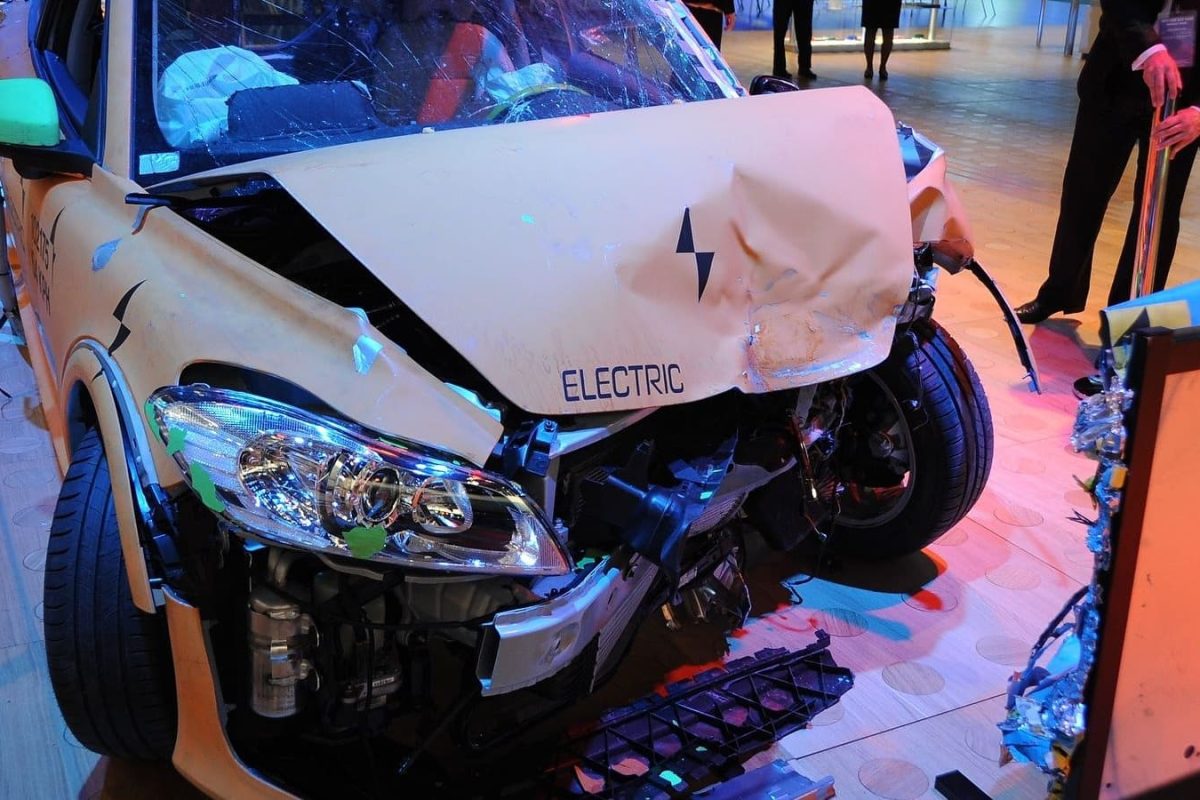
Here’s something most people learn too late. A battery pack that took a hit during your crash doesn’t necessarily burn right away. The chemical reaction building inside it can take hours to reach the point where it becomes a fire. There are documented cases of EVs reigniting in driveways, on flatbed trucks, and in parking structures the night after a collision that seemed minor at the time.
When it does go, it goes hard. The temperatures involved are extreme, and standard firefighting methods barely make a dent. Some departments have resorted to submerging the entire vehicle in water just to stop the reaction. If there was any battery damage in your crash, that’s not just a repair issue. It’s a safety issue, and it’s a legal issue that points directly at the manufacturer.
If you were involved in an EV crash, do not assume the vehicle is safe to park indoors until it has been inspected. And if there was a battery fire, the manufacturer almost certainly needs to be part of your legal claim.
What Evidence Matters Most
EV accidents require moving fast on evidence collection. The data that could prove your case exists — but it needs to be preserved before it’s gone. The most important pieces include:
- Onboard data logs — record what driver-assist features were active, speed, and system behavior in the seconds before impact. This data is in the possession of the manufacturer and can be requested or subpoenaed.
- Battery diagnostic reports — show whether the pack sustained damage and its condition at the time of the crash
- Charging station transaction records and equipment logs if relevant
- Photographs of vehicle damage, battery leakage, and post-crash fire risk
- Police reports, witness names and contact information
- Medical records documenting all injuries
The other side’s legal team will start building their defense immediately. The evidence window on an EV case is narrow.
What to Do After an Electric Vehicle Accident in California
Get medical attention first, regardless of how you feel. Then document the scene thoroughly — photographs of all vehicles, positions, damage, road conditions, and any visible battery damage or leakage.
Do not give a recorded statement to any insurance company before speaking with an attorney. EV accident claims involve multiple potential defendants and multiple insurance policies, and a statement you give to the at-fault driver’s insurer can be used against you when you try to pursue the manufacturer or another party later.
Contact an electric vehicle accident attorney as early as possible. These cases require technical knowledge that general personal injury practice doesn’t always cover — battery systems, software logs, product liability standards, and how to identify all the parties who may share responsibility for what happened to you.
Final Thoughts
Getting hit in an electric vehicle accident puts you in the middle of a liability landscape that most accident victims aren’t prepared for. The driver may be the most obvious defendant, but they may not be the most important one. The manufacturer, the software, the charging infrastructure — all of it can come into play. Knowing that going in gives you a real advantage. Getting the right legal help gives you a better one.
Pyramid Legal — Pasadena Personal Injury Attorneys
If you or a loved one were injured in an electric vehicle accident in Pasadena, Los Angeles, or anywhere in Southern California, Pyramid Legal is ready to fight for your full recovery. EV accident cases are complex — we know how to find every liable party and pursue every available source of compensation. No fees unless we win.
Get a Free Case Evaluation Today
1055 E Colorado Blvd Suite 500, Pasadena CA 91106 | 818-946-0763
Liability in an EV accident can fall on the driver, the vehicle manufacturer, the software provider, or the charging station operator depending on what caused the crash. In many cases more than one party shares responsibility, which is why EV accident cases are more complex than standard car accident claims.
Yes. If Tesla's Autopilot or Full Self-Driving feature was active and contributed to the crash, you may have a product liability claim against Tesla in addition to any negligence claim against the driver. California courts have handled multiple cases involving Autopilot. An electric vehicle accident attorney can evaluate whether a manufacturer claim applies in your situation.
Get medical attention, photograph the scene and all vehicle damage, do not give a recorded statement to any insurer, and contact an attorney as early as possible. Request that your vehicle not be repaired until it has been inspected for battery damage — EV batteries can reignite hours after a crash.
Battery fires are one of the most serious risks unique to EV crashes. They can occur hours or even days after a collision due to a process called thermal runaway. If your vehicle sustained any impact to the battery area, it should be inspected before being parked indoors or left unattended.
Yes. If faulty charging equipment damaged the battery pack before the crash or contributed to a fire or electrical failure, the charging station operator may share liability. Major charging networks carry premises liability coverage for exactly this reason.